Segmentation and Segmentation Iterators
Segmentation over a polygon mesh is also organized as a Halfedge structure. The following elements from the halfedge_element.h header file are used for segmentation representation. Each segmentation element can be either active or inactive.
A subRegion (MbSegmentationSubRegion) is a connected group of facets.
A region comprises one or more subregions, usually one. There is no separate class describing a region.
A segmentation edge is a sequence of mesh edges, where the subsequent edge starts from the vertex where the previous edge ends. It can be closed. Self-intersections are not allowed. Similar to a mesh edge, a segmentation edge contains links to its next and previous edges, its twin edge, and its associated vertex. These links are used to construct loops. If a segmentation edge belongs to an open boundary, there is no reference to the twin. Mesh edges that are part of a segmentation edge and its twin are also considered twins (see Fig. 1):
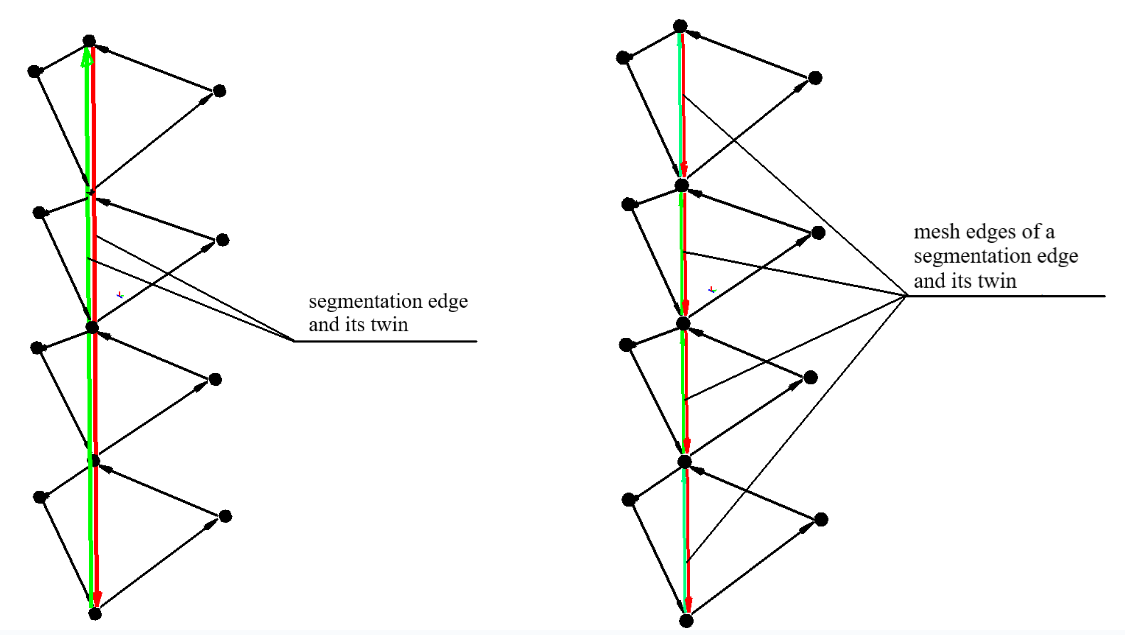
Fig. 1
A segmentation vertex corresponds to a mesh vertex where several segmentation edges are connected.
A subRegion cycle (MbSegmentationLoop) consists of a sequence of segmentation edges. A subregion can have any number of cycles, or none, if a subregion is a closed facet group. The subregion cycle has the same meaning as an edge cycle of a face in the boundary representation, with some differences. Usually, it is impossible to separate cycles into outer and inner ones on a mesh, so all cycles are treated equally. A cycle can also have “internal” edges.
An example of dividing the mesh into four regions, each consisting of a subregion, is shown in Fig. 2:
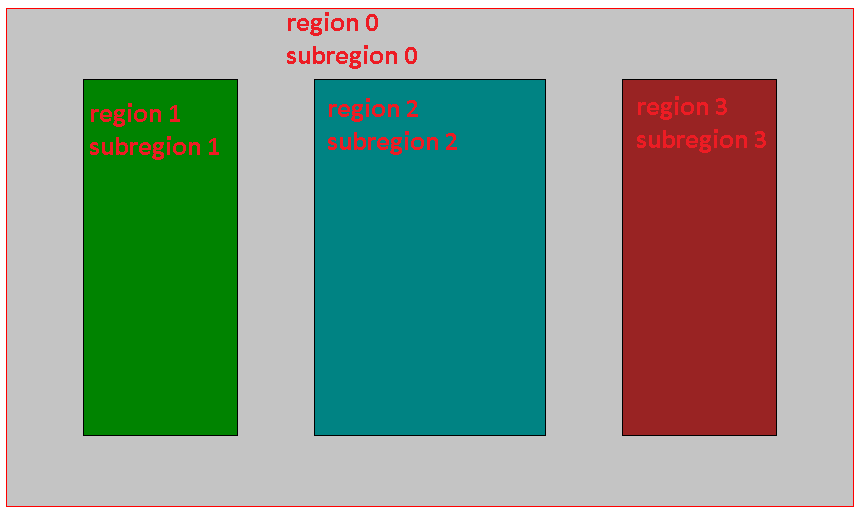
Fig. 2
An example for the same mesh, but now there are two regions in the segmentation, the first of which has one subregion and the second has three, is shown in Fig. 3:
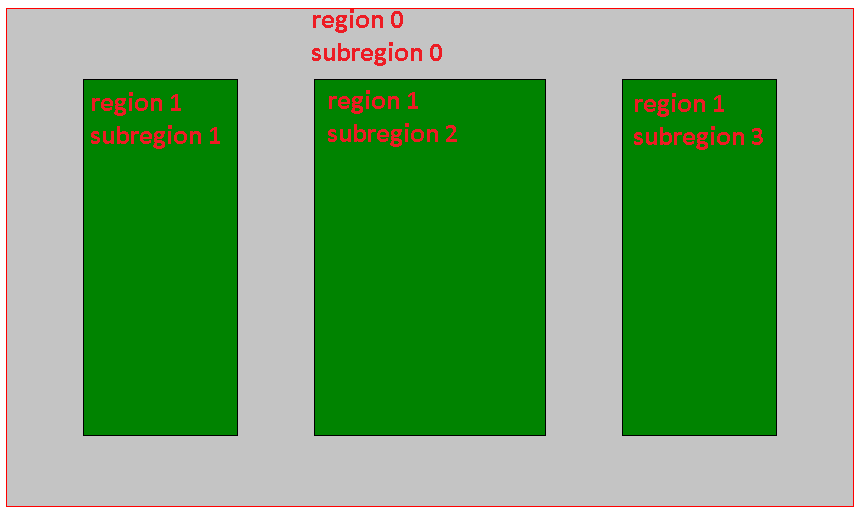
Fig. 3
An example of a two-cycle subregion is shown in Fig. 4. The green cycle consists entirely of internal edges, while the red cycle contains internal edges 1, 2, 4–9.
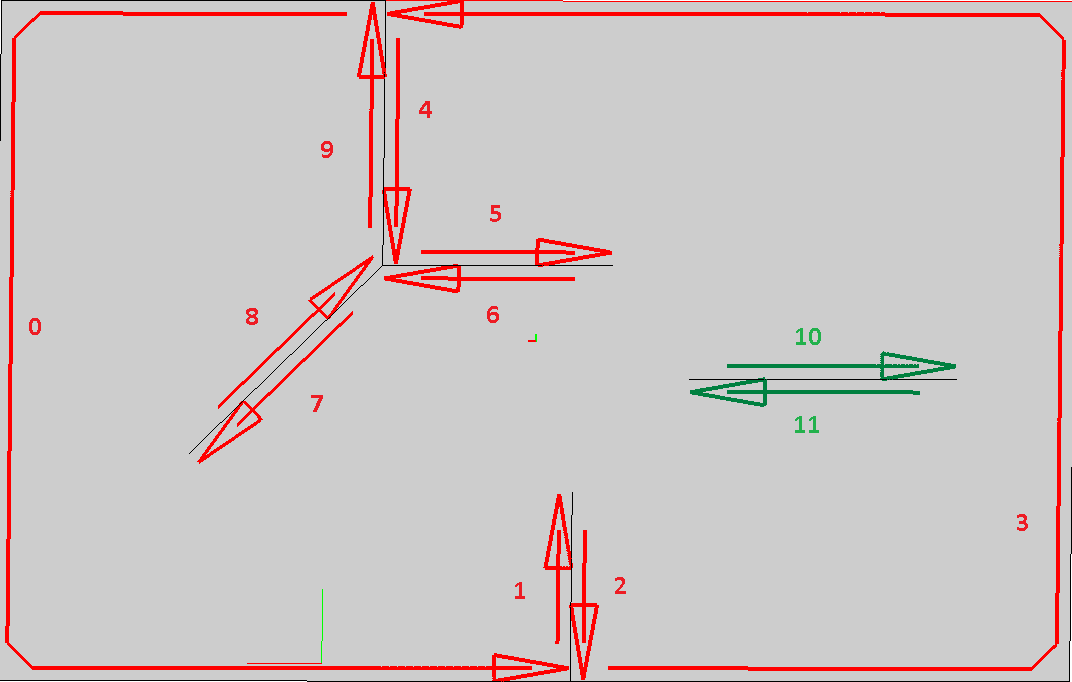
Fig. 4
The halfedge_segm_iterators.h header file provides segmentation iterators used to work with segmentation topology:
EdgeLoopIterator is an iterator over edges of subregion cycle. The iterator returns a sequence of all cycle edges or only outer edges depending on the bExcludeInnerEdges flag.
EdgeEdgesIterator is an iterator through mesh edges of a segmentation edge. The iterator returns a sequence of mesh edges in forward or reverse order depending on the bReverse flag.
SubregionRegionIterator is an iterator through subregions of a region.
LoopSubregionIterator is an iterator through subregion cycles.
To iterate through the segmentation vertex fan, use the EdgeFanIterator iterator, as shown in the example below:
MbPolymesh polymesh;

const MbPolymeshTopo & topo = *polymesh->GetTopo();

const MbHalfedge & halfedge = topo.GetMeshTopo();

for( size_t r = 0; r < topo.RegionCount(); ++r ) {

    if( !topo.IsRegionActive( r ) )
        continue;

    for( SubregionRegionIterator itSub( topo, r ); !itSub.Done(); ++itSub ) {

        for( LoopSubregionIterator itLoop( topo, itSub.Subregion() ); !itLoop.Done(); ++itLoop ) {

            for( EdgeLoopIterator itEdge( topo, itLoop.Loop() ); !itEdge.Done(); ++itEdge ) {

                for( EdgeEdgesIterator it( topo, itEdge.Edge() ); !it.Done(); ++it ) {

                    const MbHalfedgeEdge & ed = halfedge.Edge( it.Edge() );
                    ...
                }
            }
        }
    }
}

for( EdgeFanIterator it( topo.GetSegmTopo(), iVxSegm, true ); !it.Done(); ++it ) {

    const MbHalfedgeEdge & edSegm = topo.GetSegmTopo().Edge( it.Edge() );
}