Constructing Model Flat Projection
The method
void GetVestiges( const MbPlacement3D &        place,
                        double                 znear,
                  const RPArray< MbLump > &    lumps,
                  const MbProjectionsObjects & objects,
                        MbVEFVestiges &        result,
                        bool                   invisible,
                        VERSION                version );
constructs a flat projection of a set of solids and other objects.
The input parameters of the method are:
place – projection plane,
znear – observation point parameter,
lumps – solids projected in local coordinate systems,
objects – other projected objects,
invisible – flag indicating construction of invisible lines,
version – construction version, the latest version is Math::DefaultMathVersion().
The output parameter of the method is result, a structure that contains information about the projection.
The method does not return a value.
The method is declared in the map_create.h file.
The projection plane is the XY plane of the place local coordinate system.
The znear parameter determines the type of image. When znear = 0, a parallel projection of objects is constructed. The lumps parameter contains solids and matrices that transform them from the local coordinate system. The objects parameter contains auxiliary objects required to format the projection: auxiliary points, curves, conventional notations, and annotation objects. The invisible parameter indicates whether invisible lines must be constructed. In some cases, when invisible lines are not constructed, the method runs noticeably faster.
Fig. 1 shows a solid whose projection lines onto a plane parallel to the screen plane are shown in Fig. 2. Fig. 3 shows only the visible projection lines of the solid presented in Fig. 1.
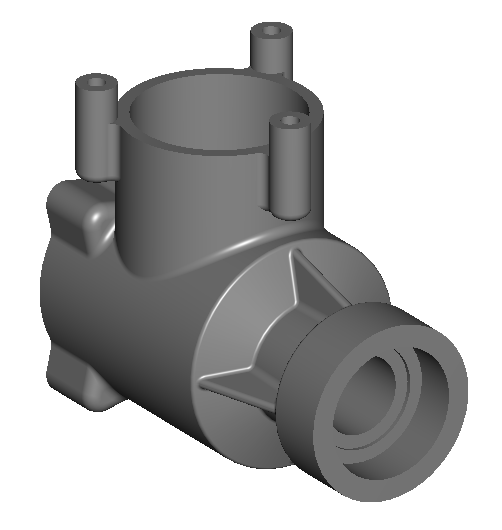
Fig. 1
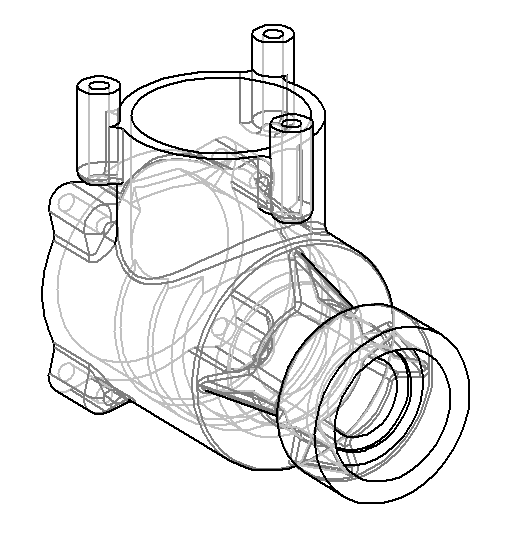
Fig. 2
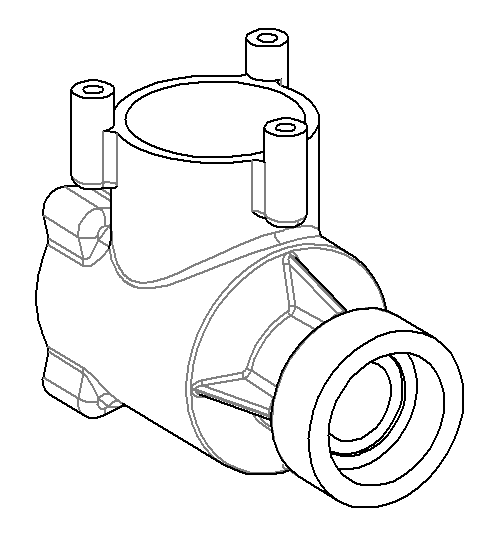
Fig. 3
The last parameter of the method is used to support previous construction versions.
The
void VisualLinesMapping( const MbPlacement3D &     place,
                               double              znear,
                         const RPArray< MbLump > & lumps,
                               MbVEFVestiges &     result,
                               bool                invisible = true );
method constructs a flat projection of a set of solids and differs from the GetVestiges() method by the absence of additional objects.