Elementary Surface Construction
The function
MbResultType ElementarySurface( const MbCartPoint3D & point0,
                                const MbCartPoint3D & point1,
                                const MbCartPoint3D & point2,
                                      MbeSpaceType    surfaceType,
                                      MbSurface *&    result );
constructs an elementary surface.
The input parameters of the function are:
point0 - a point that defines the origin of the local coordinate system of the surface.
point1 - a point that defines the direction of the axisX or axisZ axis (depending on the surface type) of the local coordinate system and the height of the surface.
point2 - a point that defines the direction of the axisY axis of the local coordinate system.
surfaceType - a surface type.
The output parameter of the function is the constructed surface result.
If successful, the function returns rt_Success; otherwise, it returns an error code from the MbResultType enumeration.
The function is declared in the action_surface.h file.
The surfaceType parameter defines the type of the surface to be created. The control points point0, point1 and point2 define the local coordinate system and dimensions of the elementary surface. The point point0 defines the origin of the local coordinate system. Table shows the surface type, the axis of the local coordinate system, and the quantity defined by the point point1 for the creation of a surface of the surfaceType type:
surfaceType |
Surface type |
The point point1 defines |
|---|---|---|
st_Plane |
plane |
axisX |
st_CylinderSurface |
cylindrical surface |
axisZ, height |
st_ConeSurface |
conical surface |
axisZ, height |
st_SphereSurface |
spherical surface |
axisZ |
st_TorusSurface |
toroidal surface |
axisX, major radius |
The point point1 defines the height of a cylindrical surface, the height of a conical surface, and the major radius of a toroidal surface. The point point2 defines the radius of a cylindrical surface, the radius of a conical surface and a cone half-angle, the radius of a sphere, and the minor radius of a toroidal surface.
When constructing a plane, the points point0, point1, and point2 define the local coordinate system of the plane with the origin at the point point0. The axisX axis of the local coordinate system of the plane is directed from the point point0 to the point point1; the axisY axis of the local coordinate system of the plane is orthogonal to the axisX axis and directed toward the point point2. The domain of the first parameter is equal to twice the distance between the points point0 and point1. The domain of the second parameter is equal to twice the distance between the point point0 and the projection of the point point2 onto the axisY axis, Fig. 1:
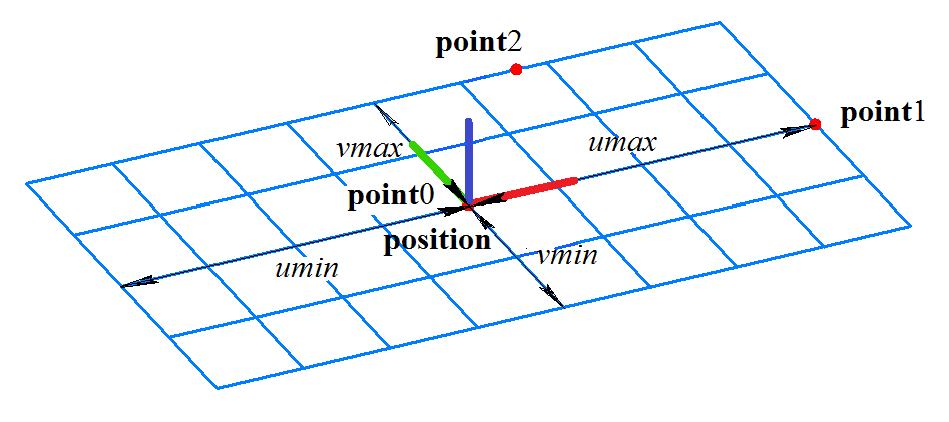
Fig. 1
When constructing a cylindrical surface, the point point0 defines the center of the bottom base of the cylinder, where the origin of the local coordinate system is located. The point point1 defines the center of the top base of the cylinder. The axisZ axis of the local coordinate system of the surface is directed from the point point0 to the point point1. The point point2 together with the previous points defines the plane of the axisX and axisZ axes of the local coordinate system of the surface. The distance between the points point0 and point1 defines the height of the cylindrical surface; the distance from the axisZ axis to the point point2 defines the radius of the cylindrical surface, Fig. 2:
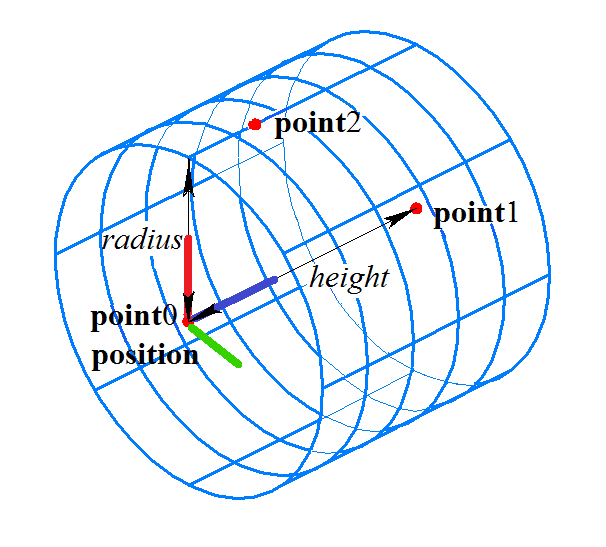
Fig. 2
The cylindrical surface is described in the section Cylindrical Surface MbCylinderSurface.
When constructing a conical surface, the point point0 defines the apex of the cone, where the origin of the local coordinate system is located. The point point1 defines the center of the cone base and the direction of the axisZ axis of the local coordinate system of the cone. The point point2 together with the previous points defines the plane of the axisX and axisZ axes of the local coordinate system of the surface. The distance between the points point0 and point1 defines the height of the conical surface. The point point2 defines the cone half-angle, when the point point2 lies on the conical surface, Fig. 3:
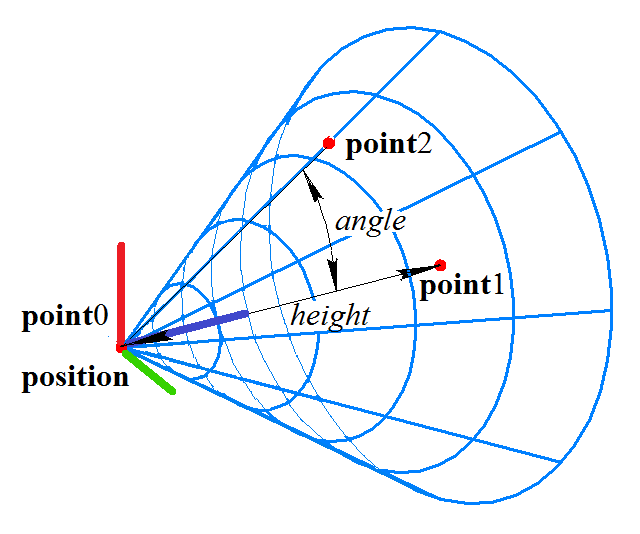
Fig. 3
The conical surface is described in the section Conical Surface MbConeSurface.
When constructing a spherical surface, the point point0 defines the center of the sphere, where the origin of the local coordinate system is located. The axisZ axis of the local coordinate system of the surface is directed from the point point0 to the point point1. The point point2 together with the previous points defines the plane of the axisX and axisZ axes of the local coordinate system of the surface. The distance between the points point0 and point2 defines the radius of the spherical surface, Fig. 4:
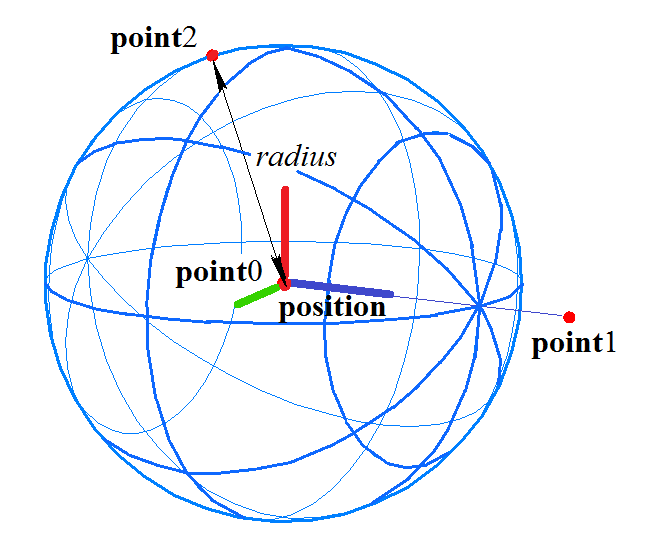
Fig. 4
The spherical surface is described in the section Spherical Surface MbSphereSurface.
When constructing a toroidal surface, the point point0 defines the center of the torus, where the origin of the local coordinate system is located. The axisX axis of the local coordinate system of the surface is directed from the point point0 to the point point1. The point point2 together with the previous points defines the plane in which the axisX and axisZ axes of the local coordinate system of the surface lie. The distance between the points point0 and point1 defines the major radius of the torus; the distance between the points point1 and point2 defines the minor radius of the torus, Fig. 5:
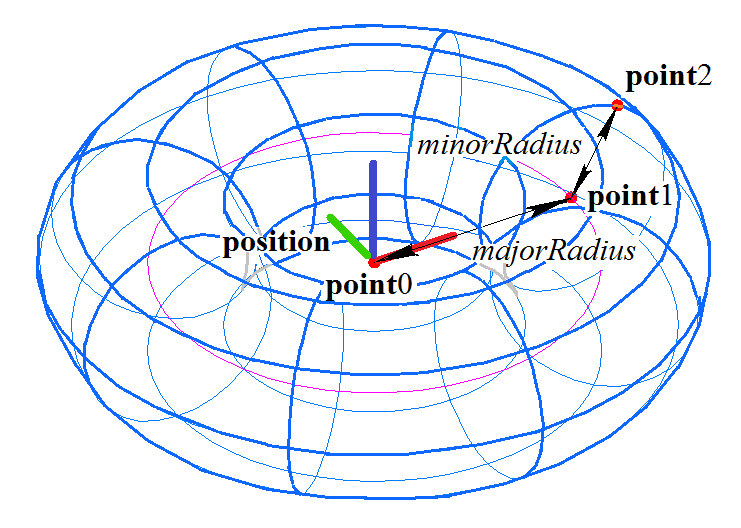
Fig. 5
The toroidal surface is described in the section Toroidal Surface MbTorusSurface.
In the test application test.exe, the construction of an elementary surface from the given points is performed by the menu command «Create→Surface→Elementary».