Model Tree Architecture
For a model created by using C3D geometric kernel objects, the following conventions are adopted:
A document is equivalent to a root component (a top-level component).
A component always corresponds to an object of type MbAssembly in the case of a boundary representation format. In the case of a polygonal representation format, an object of type MbMesh is allowed as a component. The component is expected to have assigned properties, which is expressed by the fact that the component has attributes of type MbProductInfo and MbPersonOrganizationInfo.
Own objects of a component can be objects of type MbSolid, MbWireFrame, MbPointFrame, MbSpaceInstance (both with geometry objects inside and containing MbPMI annotation elements), and MbPlaneInstance for boundary representation formats, or MbMesh for polygonal formats, which reside in MbAssembly.
Nesting of components and their positioning are performed by using objects of type MbInstance. MbInstance resides in a higher-level component and references a lower-level component. Cyclic dependencies are not allowed.
The approach in which a data exchange model is created by means of the C3D geometric kernel has several drawbacks. The most significant one is that the use of specific objects and a specific configuration makes it difficult to evolve the functionality, because any changes will require corresponding changes on the user side. The use of model, component, and instance interfaces implemented on the user side gives users independence from a specific implementation.
In terms of interfaces, the model tree architecture looks as follows:
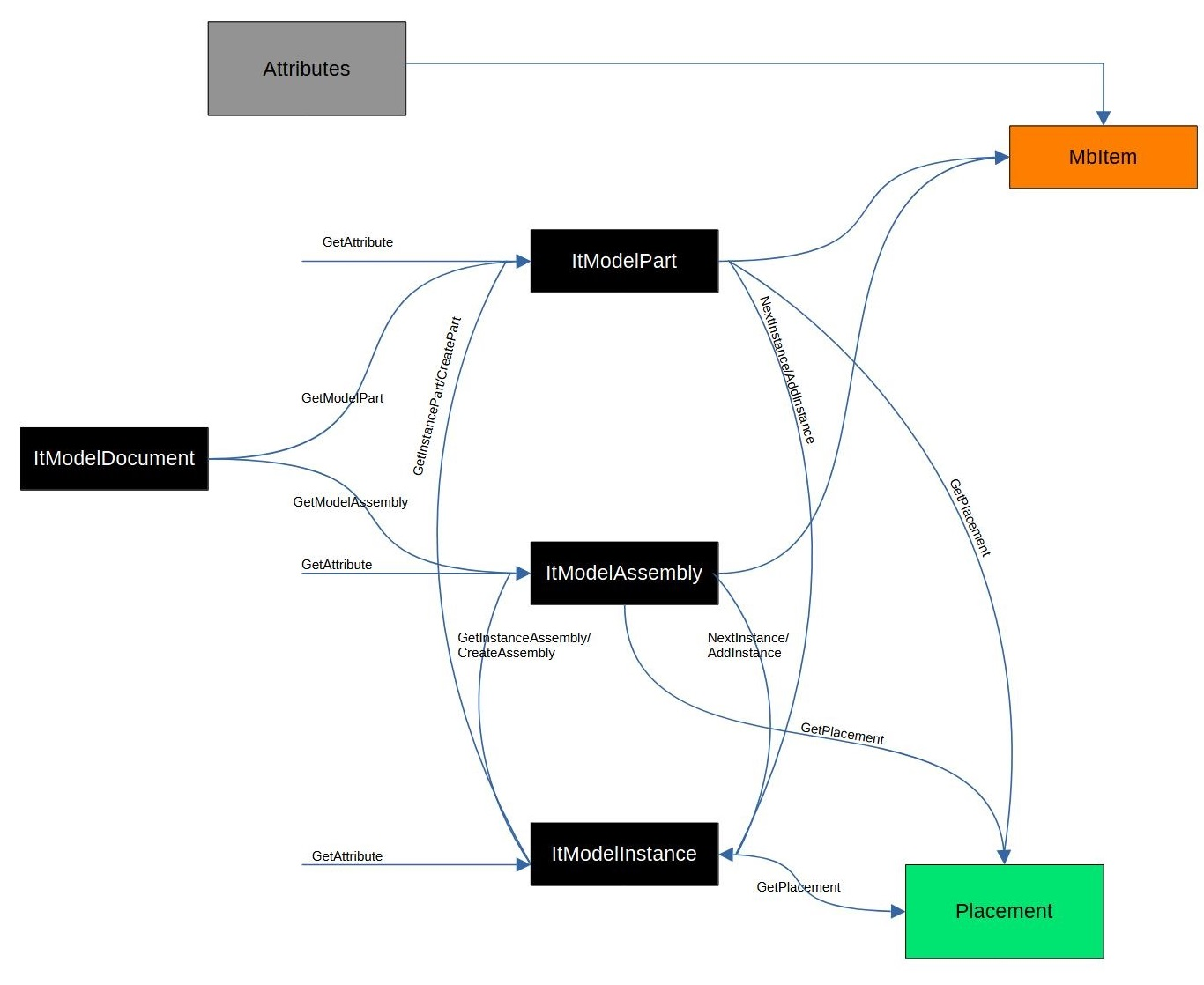
A document ItModelDocument() contains a top-level component.
Components are of two types: parts ItModelPart and assemblies ItModelAssembly. The difference between them lies only in interpretation, and both types can reference lower-level components.
Own objects of components can be objects of type MbSolid, MbWireFrame, MbPointFrame, MbSpaceInstance, and MbPlaneInstance.
Nesting of components and their positioning are performed by using ItModelInstance objects. Cyclic dependencies are not allowed.
ItModelInstanceProperties is a base class, the ancestor of the ItModelPart, ItModelAssembly, ItModelInstance interfaces. The following methods are declared in the interface:
virtual bool SetAttributes( const c3d::AttrSPtrVector & /*attributes*/ );

virtual c3d::AttrSPtrVector GetAttributes();

virtual void GetRequirements( AnnotationSptrVector &, eTextForm ); (deprecated)

virtual void SetRequirements( const AnnotationSptrVector & ); (deprecated)
The ItModelPart and ItModelAssembly interfaces have the same set of methods, so they can be considered identical up to interpretation. The assignment of component properties, visual properties, and technical requirements is implemented through the methods of the ItModelInstanceProperties base class.
The PureFileName() method is called during export and returns a string whose meaning is the component file name.
Methods for working with own items:
void GetItems( std::vector< SPtr<MbItem> > & items,
               MbeGettingItemType            itemType,
               bool                          includeInvisible );

void AddItems( const std::vector< SPtr<MbItem> > & items );

GetItems();

AddItems();
The GetItems() method is intended to output items into a container using type and visibility filters, which are formed based on the values returned by the IConvertorProperty3D:: GetIoPermission() method.
The AddItems() method is used during import and is intended for adding items to a component.
Methods for working with instances:
SPtr<ItModelInstance> PrepareInstance();

SPtr<ItModelInstance> NextInstance( bool includeInvisible );

PrepareInstance();

NextInstance();
The PrepareInstance() method is intended for inserting a component during import.
The NextInstance() method is an iterator of instances during export. It is assumed that the iterator is ready to output instances from the beginning. The sign of completion is returning a null pointer. The visibility filter value during traversal corresponds to the result of calling IConvertorProperty3D:: GetIoPermission( iop_wInvisible ).
The GetAnnotationItems( eTextForm textForm ) method is deprecated.
Methods for import via plugins:
The method
virtual void ItModelPart::AddMappedItem( MbItem &                  item,
                                         MbPlacement3D const &     placement,
                                         c3d::AttrSPtrVector const & attributes );
allows you to add an item with a given local coordinate system to the root of an assembly during import. The method is relevant only for the IFC format (see IFC Import).
Arguments:
item – an item added to the model.
placement – a local coordinate system.
The method
virtual SPtr<MbInstance> ItModelPart::NextMappedItem() const;
returns an item with a given local coordinate system or nullptr. The method is relevant only for the IFC format (see IFC Import).
The method
virtual void ItModelPart::AddAxesGrid( c3d::ItemSPtr const & );
allows you to add a grid of construction axes. The method is relevant only for the IFC format (see IFC Import).
The method
virtual c3d::ItemSPtr ItModelPart::NextAxesGrid() const;
returns the next grid of construction axes or null in case of depletion. The method is relevant only for the IFC format (see IFC Import).
The method
virtual c3d::ItemSPtr NextSpatialAxis() const { return c3d::ItemSPtr{}; }
returns the next spatial axis or null in case of depletion.
The method
virtual void AddSpatialAxis( c3d::ItemSPtr const & );
allows you to add the next spatial axis.
The method
virtual c3d::ItemSPtr ItModelPart::NextBoundaryItem();
returns the next item that bounds an area or a volume. The method is relevant only for the IFC format (see IFC Import).
The method
virtual SPtr<MbAssistingItem> ItModelPart::NextCoordinateSystem();
returns the next coordinate system or null in case of depletion. Enabling and disabling this method during import and export is possible by using the SetIoPermission( iop_rCS / iop_wCS ) filtering.
Methods for working with a model document and assemblies:
virtual void ItModelPart::AddBoundaryItem( c3d::ItemSPtr const &);
adds an item that bounds an area or a volume.
virtual void ItModelPart::AddCoordinateSystem( SPtr<MbAssistingItem> const &);
allows you to add a coordinate system. Enabling and disabling this method during import and export is possible by using the SetIoPermission( iop_rCS / iop_wCS ) filtering.
The ItModelPart and ItModelAssembly interfaces are declared in the conv_model_document.h file.
ItModelInstance Instances
The inheritance of the ItModelInstance instance interface from ItModelInstanceProperties has been established historically and is preserved for compatibility. Within the framework of the established approach, only the assignment of custom visual properties to an instance is correct.
The void * GetId() method allows distinguishing instances of equivalent components. If different instances return the same value, the equivalence is determined by the results of the content analysis. During the export process, the converter seeks to optimize the model by reusing equivalent components. A user can provide information about which components are definitely not equivalent to reduce computational costs during export.
During export, the following methods are used to obtain such information about an instance as the local coordinate system of the instance, the content of the instance, and the absence of instance content:
bool GetPlacement( MbPlacement3D & place );

bool IsAssembly();

bool IsEmpty();
If an instance is not empty, then depending on the result of the IsAssembly() method, one of the following methods is called:
SPtr<ItModelAssembly> GetInstanceAssembly();

SPtr<ItModelPart> GetInstancePart();
These methods return the interface of the component referenced by the instance.
The following methods are intended for creating components during import:
SPtr<ItModelAssembly> CreateAssembly(const MbPlacement3D &              place,
                                     const std::vector<SPtr<MbItem> > & componentItems,
                                     const c3d::path_string &           fileName );
SPtr<ItModelPart> CreatePart(      MbPlacement3D &              place,
                             const std::vector<SPtr<MbItem> > & componentItems,
                             const c3d::path_string &           fileName );
The result of these methods is a component interface whose placement in the top-level component is described by the local coordinate system place, the component is filled with elements from the componentItems container, and it corresponds to the file name fileName.
The following methods are used to place previously created components in an instance:
bool SetAssembly( const MbPlacement3D &   place,
                  const ItModelAssembly * existing );
bool SetPart( const MbPlacement3D & place,
              const ItModelPart *   existing );
The placement of the existing component is defined by the local coordinate system place.
The ItModelInstance interface is declared in the conv_model_document.h file.