MbCharacterCurve3D Character Curve
The MbCharacterCurve3D class is declared in the cur_character_curve3d.h file.
A symbolic curve is defined by the coordinate functions xFunction, yFunction, zFunction, the local coordinate system MbPlacement3D position of the functions, the transformation matrix transform, the boundary values of the parameter domain tmin and tmax, the periodicity flag of the curve closed, and the type of the coordinate system (Cartesian, cylindrical, spherical) coordinateType in which the coordinate functions are specified. The curve also has some additional data that is optional and is used to speed up the curve methods.
The coordinate functions xFunction(t), yFunction(t), zFunction(t) of the symbolic curve are scalar functions of the common parameter t and are given as symbolic expressions. For each symbolic expression, lexical analysis is performed and a tree is built that computes the value of the symbolic expression for a given parameter and the derivatives of the symbolic expression with respect to the parameter. The curve parameter t takes values on the segment tmin ≤ t ≤ tmax.
In the PointOn( double & t, MbCartPoint3D & r) method, the radius vector of the curve r is described by the vector function
The character curve is shown in Fig. 1:
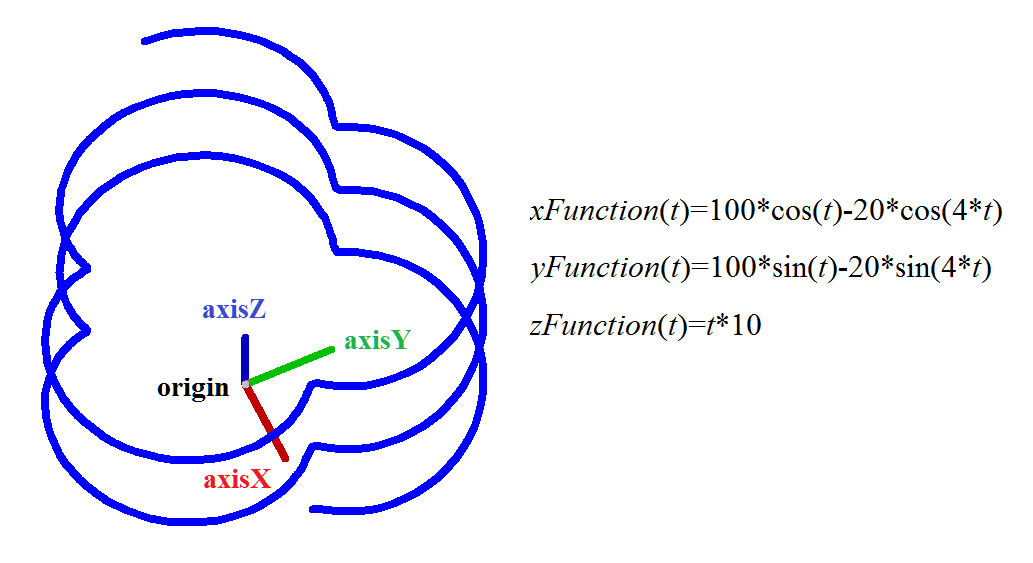
Fig. 1
The curve can be periodic. The symbolic expressions on the curve domain must represent continuous, finite, and single-valued functions.
The parser of input expressions recognizes basic mathematical operations with respect to priorities and parentheses: addition (+), subtraction (-), multiplication (*), division (/), exponentiation (^), and unary minus (-). Operations are performed on variables, constants, and functions.
The parser recognizes the names of basic mathematical functions listed in Table 1:
Function name |
Description |
|---|---|
sin |
Sine |
cos |
Cosine |
tan |
Tangent |
sind |
Sine, input argument in degrees |
cosd |
Cosine, input argument in degrees |
tand |
Tangent, input argument in degrees |
asin |
Arc sine |
acos |
Arc cosine |
atan |
Arc tangent |
asind |
Arc sine, output value in degrees |
acosd |
Arc cosine, output value in degrees |
atand |
Arc tangent, output value in degrees |
sqrt |
Square root |
exp |
Exponential |
ln |
Natural logarithm |
lg |
Decimal logarithm |
deg |
Function converting radians to degrees |
rad |
Function converting degrees to radians |
abs |
Absolute value |
Unnamed constants (numbers) can be specified as floating-point numbers (a string of digits separated by a dot) or as integers.
Named constants can be used in symbolic expressions and are listed in Table 2:
Constant name |
Description |
|---|---|
M_PI |
π — ratio of the circle circumference to its diameter |
M_PI_2 |
π / 2 |
M_PI_4 |
π / 4 |
M_SQRT2 |
√2 |
M_E |
e — base of the natural logarithm |
M_FI |
φ — golden ratio |
M_RADDEG |
180 / π — conversion factor from radians to degrees |
M_DEGRAD |
π / 180 — conversion factor from degrees to radians |
The name of a variable in an analytical expression can be a sequence of string and numeric literals (the first character is a string literal) that does not coincide with function names or constant names.
Constraints for creating a symbolic curve:
Maximum variable length — 512 characters.
Maximum expression length — 2048 characters.
No operations of integration, differentiation, or limit evaluation.
No simplification of mathematical expressions (for example, fraction reduction).
Due to these constraints, correct evaluation of an analytical expression can be obtained only for relatively simple mathematical expressions and functions. For example, the value of sin(x)/x at zero may be computed incorrectly.
Below is a code example demonstrating how to create a symbolic three-dimensional curve.
MbCharacterCurve3D * CreateAnalyticalCurve3D()
{
    MbCharacterCurve3D * curve( nullptr );

    // String representations of the given coordinate functions.
    string_t xFunction = _T( "100*cos(t)-20*cos(4*t)" );
    string_t yFunction = _T( "100*sin(t)-20*sin(4*t)" );
    string_t zFunction = _T( "t*10" );
    string_t argument  = _T( "t" );

    double t1 = 0.0, t2 = 5.0 * M_PI;

    // Creating analytical coordinate functions using the function factory.
    MbFunctionFactory factory;

    SPtr<MbFunction> x( factory.CreateAnalyticalFunction( xFunction, argument, t1, t2, true ) );
    SPtr<MbFunction> y( factory.CreateAnalyticalFunction( yFunction, argument, t1, t2, true ) );
    SPtr<MbFunction> z( factory.CreateAnalyticalFunction( zFunction, argument, t1, t2, true ) );

    if ( x != nullptr && y != nullptr && z != nullptr ) {
        MbCartPoint3D point( 0.0, 0.0, 0.0 );           // Origin of the local coordinate system.
        MbVector3D    axisX( 1.0, 0.0, 0.0 );
        MbVector3D    axisY( 0.0, 1.0, 0.0 );

        MbPlacement3D place( point, axisX, axisY );     // Local coordinate system.

        MbeLocalSystemType3D cs = ls_CartesianSystem;   // Type of the local coordinate system.

        // Creating a symbolic three-dimensional curve.
        curve = new MbCharacterCurve3D( *x, *y, *z, cs, place, t1, t2 );
    }

    return curve;
}