Constructing a Deformable Body
Construction of a deformable body is performed by a user in several sequential steps, each of which is implemented by a separate function. The goal is to obtain the body result in which the selected faces of the initial body solid are replaced with deformable faces.
At the first step, the faces are prepared for deformation: a parameter object of type NurbsValues is created and one of the functions ModifiedNurbsItem is called, either the variant with an array of faces faces or the variant with a single face face. As a result, the body result is obtained, in which the specified faces of the initial body solid are replaced with NURBS-surfaces suitable for further modification.
If necessary, for a selected face face of the body result the function GetControlSurface is called and a copy of the base NURBS-surface of the face face is obtained, which can be modified independently of the body.
If the shape of a face is to be controlled through its control points, the function FaceControlPoints is called for the face face to obtain the matrix of control points and their weights. The user changes the coordinates of the control points and/or their weights according to the required deformation.
After the modifications have been made, the deformation is applied to the body using one of the functions NurbsModification. In the variant with a surface, the modified surface faceSurface and the fixed points are passed. In the variant with control points, the modified control points, the weights and the fixed points are passed. In both cases, the output is the modified body result with a changed shape of the selected face.
The function
MbResultType ModifiedNurbsItem(      MbSolid &         solid,
                                     MbeCopyMode       sameShell,
                               const NurbsValues &     p,
                               const RPArray<MbFace> & faces,
                               const MbSNameMaker &    names,
                                     MbSolid *&        result )
replaces the selected faces of the solid with deformable faces for further editing.
The input parameters of the function are:
solid – the initial solid;
sameShell – the mode of copying of the initial solid;
p – an object containing transformation parameters;
faces – the faces of the solid to be replaced;
names – a name maker of the operation.
The output parameter of the function is the constructed solid result.
If successful, the function returns rt_Success; otherwise it returns an error code from the enumeration MbResultType (see mb_operation_result.h).
The function is declared in the file action_direct.h.
When the object p with modification parameters is created, the following constructor of parameters is used (see op_shell_parameter.h):
ud, vd – the order of the NURBS copy in the u- and v-directions;
uc, vc – the number of control points in the u- and v-directions;
umin, umax, vmin, vmax – parameter ranges in u and v for deforming the face;
uapprox, vapprox – flags that allow an approximating surface to be constructed instead of an exact one.
NurbsValues( size_t ud, size_t uc, double umin, double umax, bool uapprox,
             size_t vd, size_t vc, double vmin, double vmax, bool vapprox )
: uParameters( ud, uc, umin, umax, uapprox )
, vParameters( vd, vc, vmin, vmax, vapprox )
{}
The object p stores two sets of parameters of type MbNurbsParameters: uParameters and vParameters. The parameters ud, uc, umin, umax, uapprox define the fields of uParameters, and the parameters vd, vc, vmin, vmax, vapprox define the fields of vParameters.
The considered function copies the solid solid (depending on the parameter sameShell) and prepares the copy of the solid for further deformation of the specified faces of the initial solid.
The parameter solid contains the initial solid in which the specified faces will be replaced with deformable faces based on NURBS-surfaces.
The parameter sameShell controls the transfer of faces, edges and vertices from the initial solid solid to the constructed solid result and can take one of four values:
cm_Same = 0 (the solid is not copied);
cm_KeepHistory (the initial shell and its copy share base surfaces, vertices and faces that are not changed by the operation);
cm_KeepSurface (the initial solid and its copy share base surfaces);
cm_Copy (the initial solid and its copy do not share any data).
The enumeration MbeCopyMode is declared in the file mb_enum.h and is described in detail in Copying a Set of Faces MbFaceShell.
The parameter faces contains the set of faces of the solid solid that will be replaced with deformable faces based on NURBS-surfaces in the constructed solid result.
The parameter names is used for naming new faces, edges and vertices and for versioning of the operation.
The function
MbResultType ModifiedNurbsItem(      MbSolid &      solid,
                                     MbeCopyMode    sameShell,
                               const NurbsValues &  params,
                               const MbFace &       face,
                               const MbSNameMaker & names,
                                     MbSolid *&     result )
replaces a single face of the solid with a deformable face for further editing. This function differs from the one described above only in the fourth parameter, which contains not a set of faces but a single face face to be replaced.
The function is declared in the file action_direct.h.
The constructed body result may look similar to the original body solid, but unlike the original body it has NURBS surfaces available for modification. Fig. 1 shows an initial cylindrical solid solid whose side face is a cylinder MbCylinderSurface and the solid result with a side face based on a NURBS-surface. The control points of the NURBS-surface are also shown in Figure.
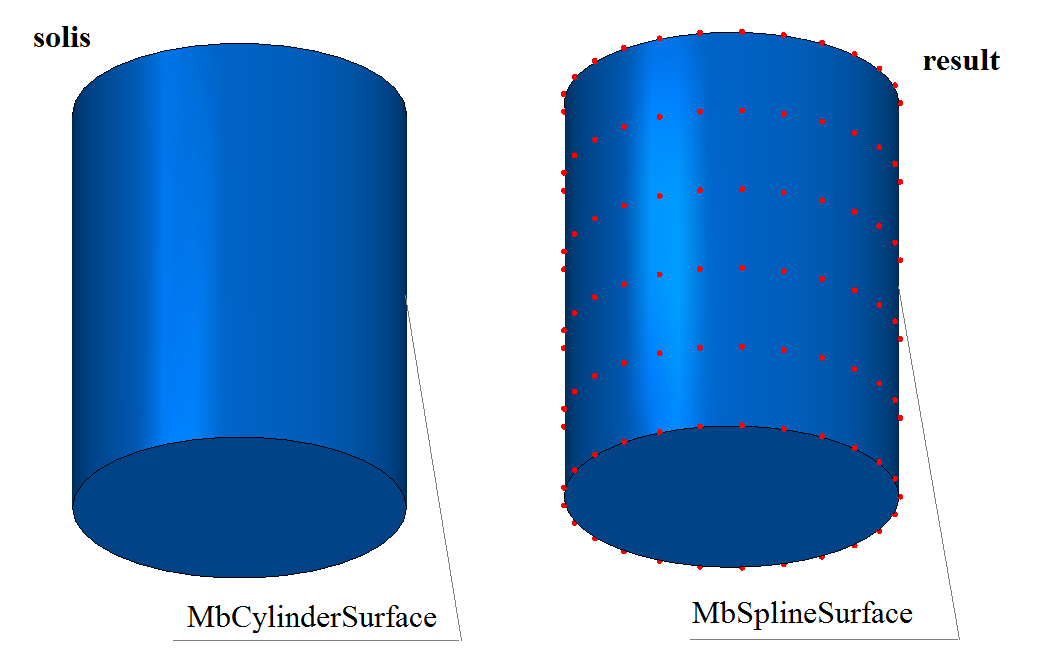
Fig. 1
The functions ModifiedNurbsItem() add to the history of the constructed solid the builder MbModifiedNurbsItem, which contains all data required to perform the operation. The builder MbModifiedNurbsItem is declared in the file cr_modified_nurbs_.h.
The function
MbSurface * GetControlSurface( const MbFace & face )
creates a deformable NURBS-surface of the face face for further editing.
The input parameter of the function is the initial face face.
The function is declared in the file action_direct.h.
The function returns a non-null pointer to a surface if the face face is based on a NURBS-surface. This requirement is satisfied after successful execution of the functions ModifiedNurbsItem(). The function returns a pointer to a copy of the base surface of the face face, not to the base surface of the face itself. The control points and their weights of the returned surface can then be modified.
The function
MbResultType FaceControlPoints( const MbFace &                face,
                                      Array2<MbCartPoint3D> & controlPoints,
                                      Array2<double> &        result )
returns the set of control points of the surface of a face and the set of their weights.
The input parameter of the function is the initial face face.
The output parameters of the function are:
controlPoints – the control points of the face;
result – the weights of the control points.
The function is declared in the file action_direct.h.
The function returns rt_Success if the face face is based on a NURBS-surface; otherwise it returns an error code from the enumeration MbResultType (see mb_operation_result.h). By changing the positions of the control points controlPoints and changing the weights in result, one can change the shape of the surface. The considered function should be used after successful execution of the functions ModifiedNurbsItem() described above.
The control points controlPoints are passed as a rectangular matrix whose rows correspond to the first parameter of the NURBS-surface and whose columns correspond to the second parameter of the NURBS-surface. That is, the points lying in one row of the rectangular matrix controlPoints are arranged along a coordinate line of the surface with a fixed second parameter of the NURBS-surface, and the points lying in one column of the rectangular matrix controlPoints are arranged along a coordinate line of the surface with a fixed first parameter of the NURBS-surface. In Fig. 2 the control points are shown against the background of the coordinate lines of the surface.
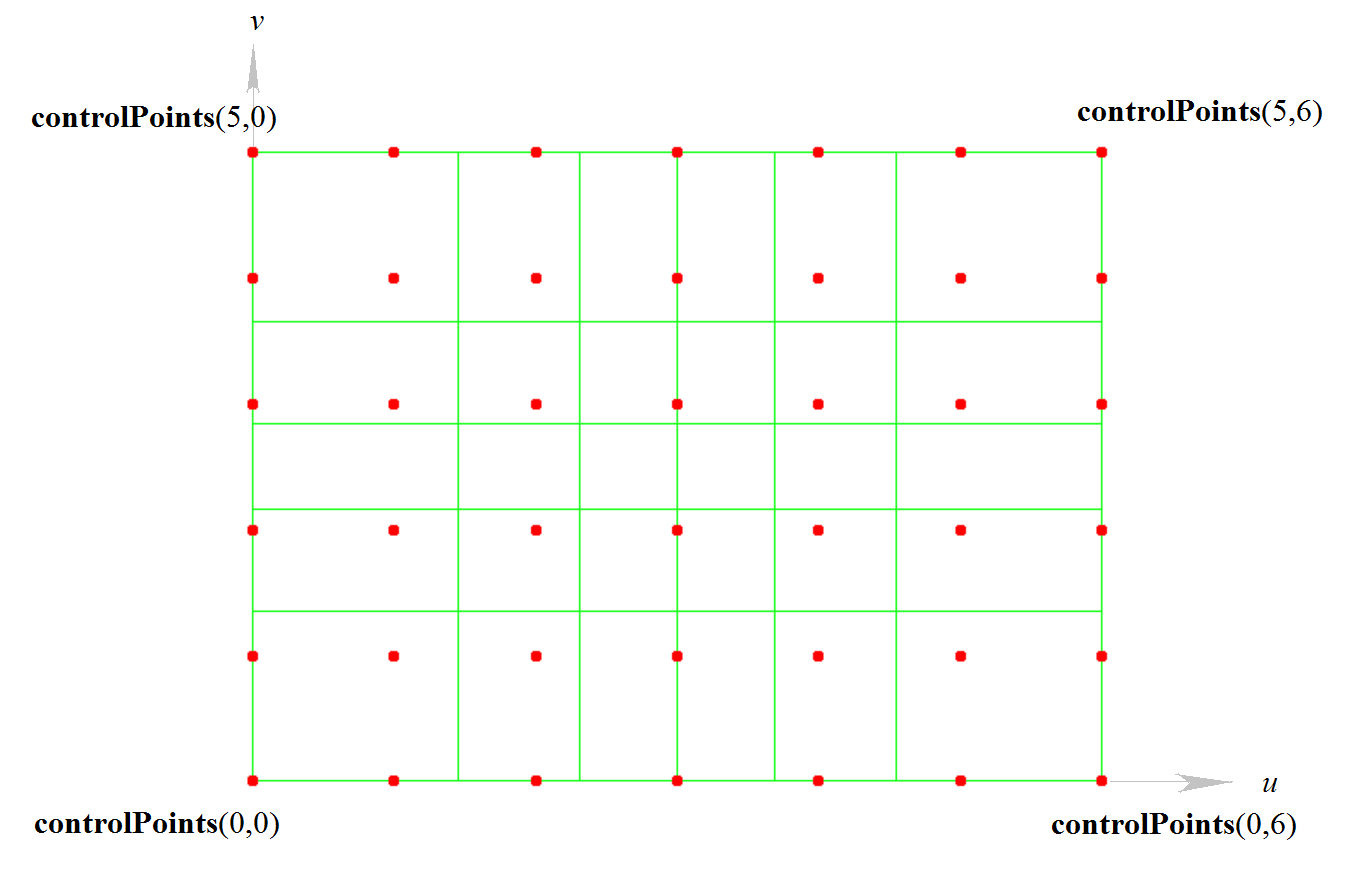
Fig. 2
The rectangular matrix result of weights corresponds to the rectangular matrix of control points controlPoints.
Fig. 3 shows the face face and the control points controlPoints of its surface leftward and the edited control points controlPoints for subsequent modification of the face face on the right.
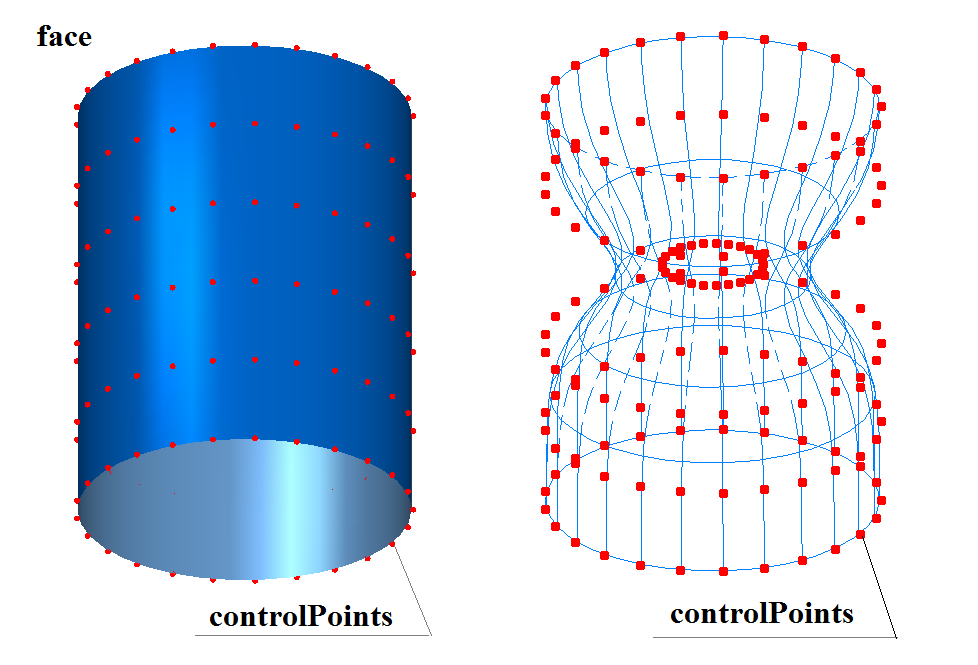
Fig. 3
The function
MbResultType NurbsModification(       MbSolid &       solid,
                                      MbeCopyMode     sameShell,
                                      MbFace *        face,
                                      MbSurface &     faceSurface,
                                      Array2<bool> &  fixedPoints,
                                const MbSNameMaker &  names,
                                      MbSolid *&      result )
deforms the specified face of the initial solid by substituting the given surface into the modified face.
The input parameters of the function are:
solid – the initial solid;
sameShell – the mode of copying of the initial solid;
face – the face of the solid to be modified;
faceSurface – the new NURBS-surface of the face;
fixedPoints – the fixed points (if the fixedPoints pointer is equal to nullptr, all control points are considered movable);
names – a name maker of the operation.
The output parameter of the function is the constructed modified solid result.
If successful, the function returns rt_Success; otherwise it returns an error code from the enumeration MbResultType (see mb_operation_result.h).
The function is declared in the file action_direct.h.
The considered function copies the solid solid and substitutes the given surface faceSurface into the copy of the face face of the solid solid.
The enumeration MbeCopyMode is described in detail in Copying a Set of Faces MbFaceShell.
The surface faceSurface must be a NURBS-surface. The parameter fixedPoints is a rectangular matrix whose rows and columns correspond to the rows and columns of the matrix of control points of the NURBS-surface faceSurface. The elements of the matrix with the value true define fixed control points of the NURBS-surface.
The function
MbResultType NurbsModification(      MbSolid &               solid,
                                     MbeCopyMode             sameShell,
                                     MbFace *                face,
                               const Array2<MbCartPoint3D> & controlPoints,
                               const Array2<double> &        weights,
                                     Array2<bool> *          fixedPoints,
                               const MbSNameMaker &          names,
                                     MbSolid *&              result )
deforms the specified face of the initial solid using the given control points and their weights.
The input parameters of the function are:
solid – the initial solid;
sameShell – the mode of copying of the initial solid;
face – the face of the solid to be modified;
controlPoints – the given control points of the face to be modified;
weights – the weights of the control points;
fixedPoints – the fixed points (if the fixedPoints pointer is equal to nullptr, all control points are considered movable);
names – a name maker of the operation.
The output parameter of the function is the constructed solid result.
If successful, the function returns rt_Success; otherwise it returns an error code from the enumeration MbResultType (see mb_operation_result.h).
The function is declared in the file action_direct.h.
The considered function should be used after successful execution of the functions ModifiedNurbsItem(), GetControlSurface() and FaceControlPoints() described above. The functions ModifiedNurbsItem() prepare the faces for modification.
Fig. 4 shows an initial cylindrical solid solid whose side face is based on a NURBS-surface and whose control points are to be modified. Also Fig. 4 shows the solid result with a modified side face; the control points controlPoints of this face are shown in the figure.
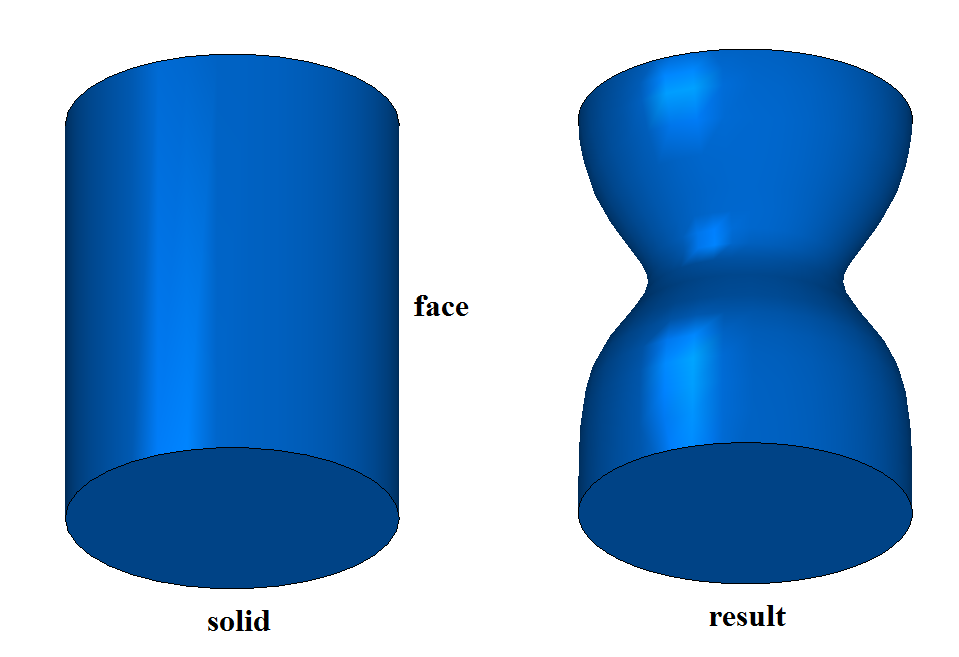
Fig. 4
The functions NurbsModification() add to the history of the constructed solid the builder MbNurbsModification, which contains all data required to perform the operation. The builder MbNurbsModification is declared in the file cr_modified_nurbs_.h.