Splitting Body Faces
The function
MbResultType SplitSolid(       MbSolid &                    solid,
                               MbeCopyMode                  sameShell,
                         const RPArray<MbSpaceItem> &       spItems,
                               bool                         spSame,
                               RPArray<MbFace> &            selFaces,
                         const MbMergingFlags &             flags,
                         const MbSNameMaker &               names,
                               MbSolid *&                   result );
splits the specified body faces with spatial curves, surfaces and shells. The spatial splitting elements must not have full or partial overlaps and self-intersections.
The input parameters of the function are:
solid - the source body;
sameShell - a copy mode for the source body;
spItems - spatial splitting elements of faces;
spSame - the flag controlling use of spatial splitting elements;
selFaces - the set of faces to be split;
flags - flags controlling merging of shell elements;
names - a name maker.
The output parameter of the function is the constructed body result.
The function returns a result code from the MbResultType enumeration.
The function is declared in the file action_solid.h.
The function splits the specified faces selFaces of the source body solid with spatial objects spItems, if the specified faces intersect these objects. The objects in spItems may be curves, surfaces, or a solid.
For successful operation, cutting objects must fully intersect the specified faces of the source body.
Parameter sameShell controls the transfer of faces, edges and vertices from the source body solid to the constructed body result and may take one of four values:
cm_Same = 0 (shell is not copied);
cm_KeepHistory (the source shell and its copy share common base surfaces, vertices, and faces unchanged by the operation);
cm_KeepSurface (the source shell and its copy share common base surfaces);
cm_Copy (the source shell and its copy have no shared data).
Enumeration MbeCopyMode is described in section Copying a Set of Faces MbFaceShell.
The parameter spSame controls copying of spatial splitting elements (true – use originals, false – use copies).
Parameter flags controls merging of shell elements after splitting:
flags.mergeFaces = true – merge geometrically similar faces arising as a result of splitting;
flags.mergeEdges = true – merge geometrically similar edges.
The parameter names provides naming of the faces, edges, and vertices of the constructed body.
Fig. 1 shows the source body solid, the faces for splitting selFaces, and the cutting surface spItems[0].
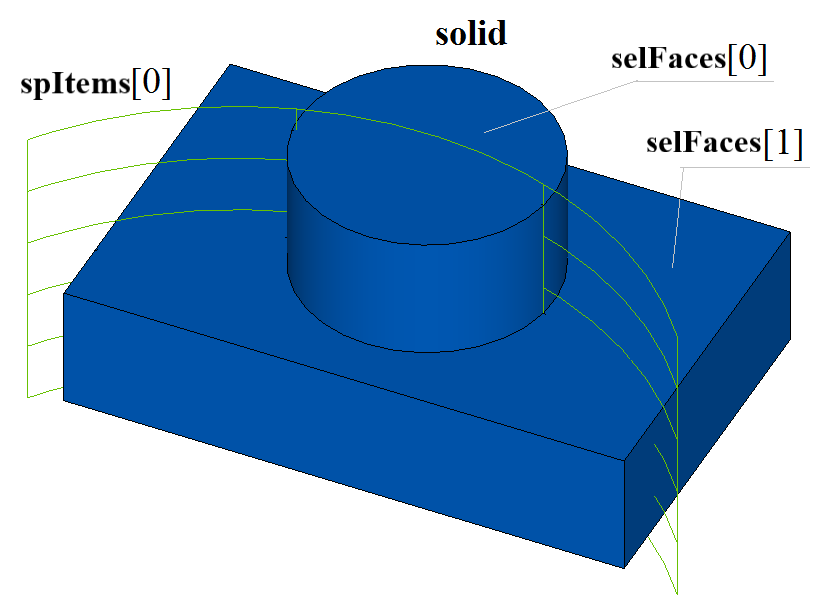
Fig. 1
Fig. 2 shows the constructed body result with faces split into parts. New edges return true when queried with MbEdge::IsSplit().
In Fig. 3, the split faces of the constructed body are painted in different colors:
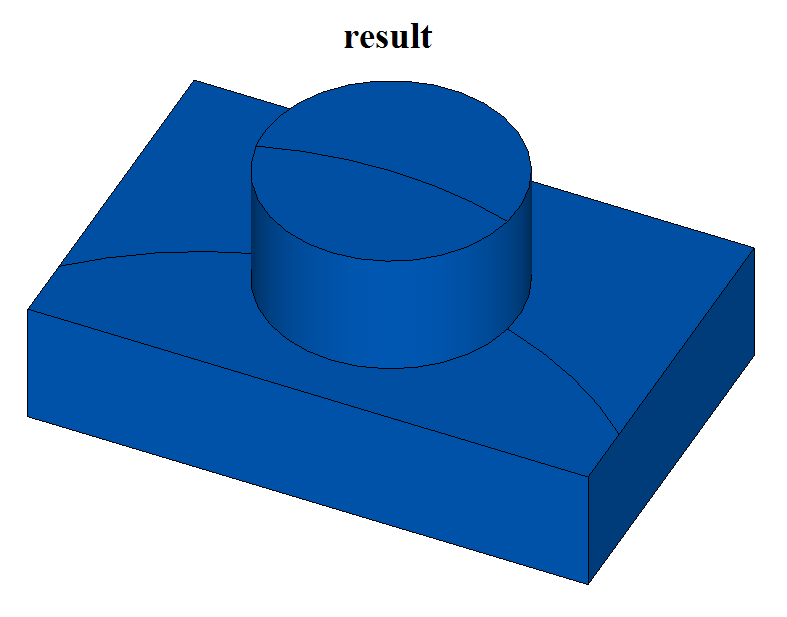
Fig. 2
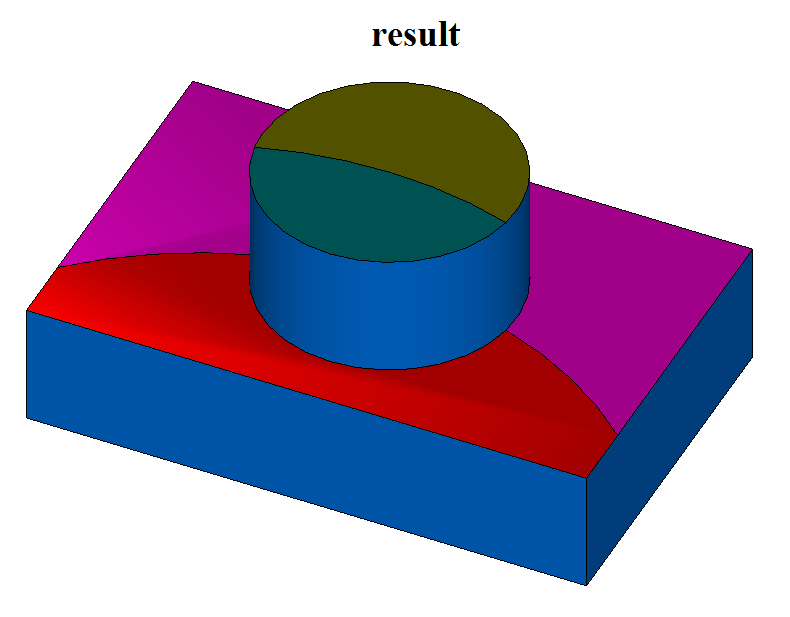
Fig. 3
The function
MbResultType SplitSolid(       MbSolid &                    solid,
                               MbeCopyMode                  sameShell,
                         const MbPlacement3D &              spPlace,
                               MbeSenseValue                spType,
                         const RPArray<MbContour> &         spContours,
                               bool                         spSame,
                               RPArray<MbFace> &            selFaces,
                         const MbMergingFlags &             flags,
                         const MbSNameMaker &               names,
                               MbSolid *&                   result );
performs the same operations as the function considered above with the difference that instead of splitting objects spItems, the splitting of the body solid faces is performed by surfaces constructed by extrusion of two-dimensional contours spContours located in the XY plane of the local coordinate system spPlace. Extrusion of contours is performed in the direction of the spPlace.axisZ axis of the local coordinate system for a length sufficient to fully intersect the source body.
Functions SplitSolid() add to the history log of the constructed body the builder MbSplitShell, which contains all necessary data for performing the operation. The builder MbSplitShell is declared in the file cr_split_shell.h.
In the test application test.exe, splitting of the specified body faces is performed by the menu command «Create → Solid → By faces processing → Face splitting».