MbFaceShell Set of Faces
Class MbFaceShell is declared in file topology_faceset.h.
Set of faces MbFaceShell is a derived class of the topological object MbTopItem. The data structure of MbFaceShell contains a set of faces RPArray<MbFace> faceSet and a closedness flag closed of the face set. The face set also has some additional data that are optional and serve to speed up methods of the face set.
The face set usually describes a connected portion of the surface of a modeled object. Faces of the set that are connected to each other satisfy certain conditions, namely: faces join each other along common edges; at each edge only two faces meet; moreover, faces join so that the outer side of one face passes into the outer side of another face, and the common surface formed by the adjoining faces must not have self-intersections.
Fig. 1 shows a set of faces connected to each other. All face edges belong to two loops; for all edges the pointers facePlus and faceMinus are not null, and the curves MbSurfaceIntersectionCurve on which the face edges are constructed have curveOne.surface != curveTwo.surface.
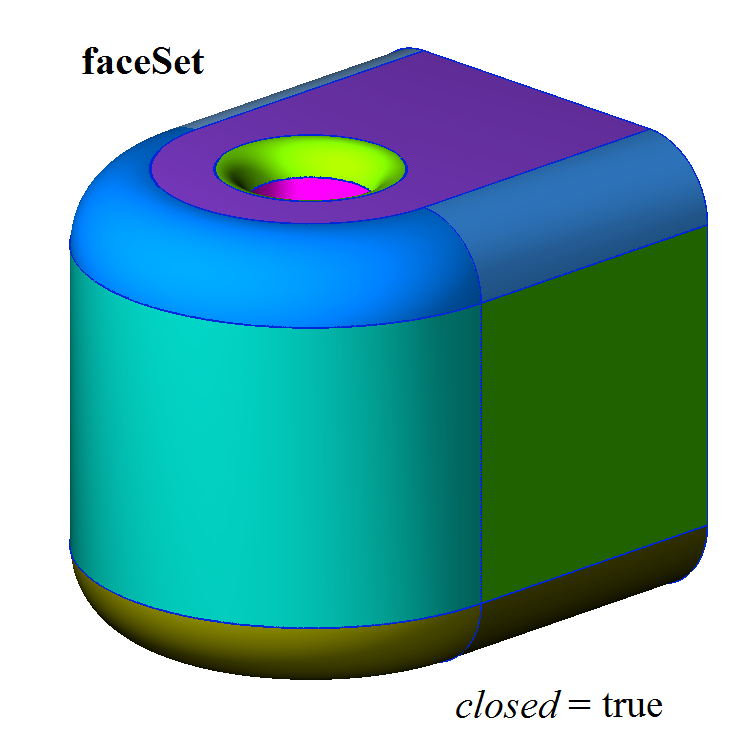
Fig. 1
The faces shown in the figure form a common closed surface; the outer side of each face passes into the outer side of the neighboring face. For a face set that has no boundary edges, the closed flag takes the value true.
If at least one face of the set has at least one boundary edge, then the closed flag of the face set takes the value false. Fig. 2 shows a set of faces, some of which have boundary edges. Boundary edges belong only to one loop, and for boundary edges of a face only one of the pointers facePlus or faceMinus is not null, while the curves MbSurfaceIntersectionCurve on which the edges are constructed have curveOne.surface == curveTwo.surface and parameter buildType = cbt_Boundary. A pole edge is not a boundary edge, because it does not form a border.
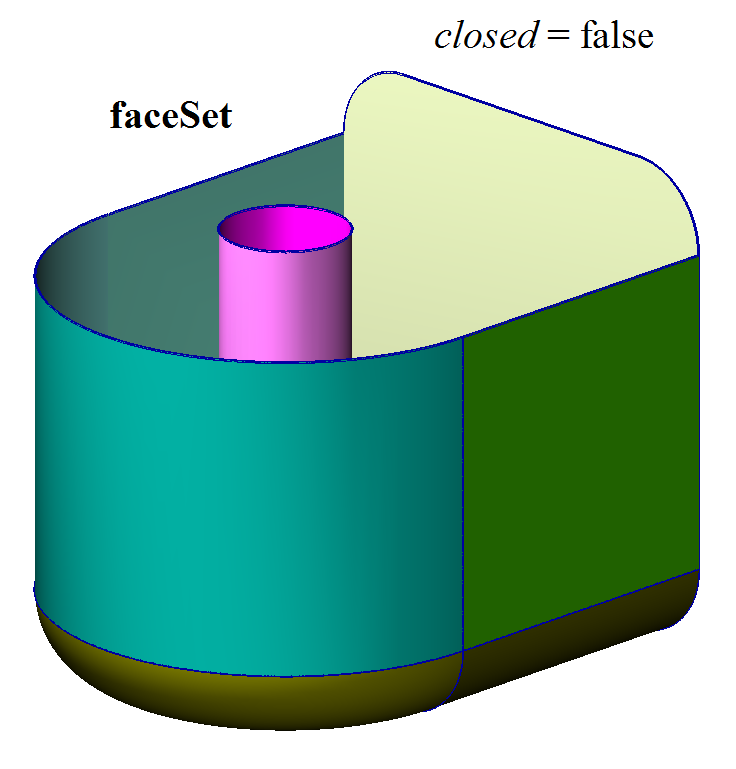
Fig. 2
A connected face set is called a closed shell if the faces of the set have no border. If faces adjoining each other have at least one boundary edge, then such a connected face set is called an open shell. Note that a closed shell and an open shell represent a connected set of faces adjoining each other.
A face set may consist of several parts that are not connected to each other. Fig. 3 shows a face set describing two open shells.
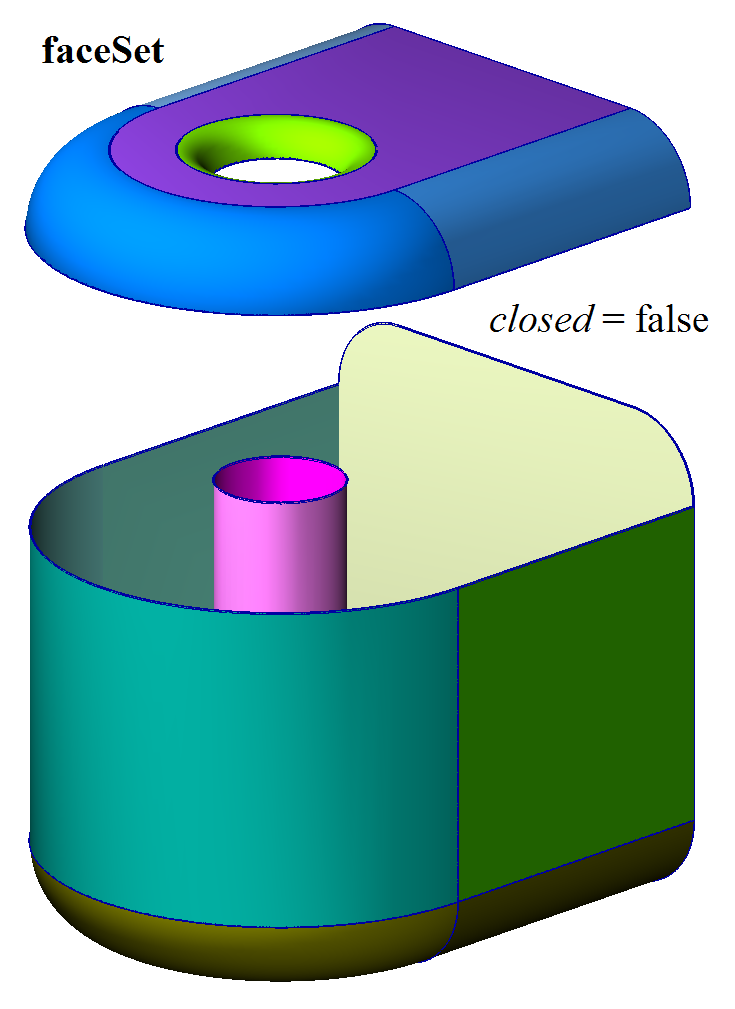
Fig. 3
Formally, no constraints are imposed on faces of the set. A face set may consist of separate faces. Fig. 4 shows a set of faces that are not connected to each other. Each face shown in the figure forms a separate shell; all edges of the faces are boundary edges.

Fig. 4
The main methods of a shell are methods for transforming it in space:
void Move( const MbVector3D & v, MbRegTransform * iReg = NULL ),
void Rotate( const MbAxis3D & axis, double angle, MbRegTransform * iReg = NULL ),
void Transform( const MbMatrix3D & m, MbRegTransform * iReg = NULL ),
methods for searching faces, edges, and vertices, as well as methods for determining the position of a point relative to a closed shell:
bool DistanceToBound( const MbCartPoint3D &, …),
bool PointClassification( const MbCartPoint3D &, …).
An open shell describes only a part of the boundary surface of a modeled object. Open shells are used for surface modeling. If a closed shell is supplemented with a set of points lying inside it, then we obtain a solid body. Closed shells are used for solid modeling. Trimming and joining of faces are performed simultaneously with shell construction. This is provided by methods of the C3D geometric kernel. Objects of a geometric model are constructed on the basis of closed and open shells.