NURBS Surface Construction
The function
MbResultType SplineSurface( const MbCartPoint3D & pUMinVMin,
                            const MbCartPoint3D & pUMaxVMin,
                            const MbCartPoint3D & pUMaxVMax,
                            const MbCartPoint3D & pUMinVMax,
                                  size_t          uCount,
                                  size_t          vCount,
                                  size_t          uDegree,
                                  size_t          vDegree,
                                  MbSurface *&    result );
constructs a NURBS surface by corner control points.
The input parameters of the function are:
pUMinVMin is a left lower corner point of the surface;
pUMaxVMin is a right lower corner point of the surface;
pUMaxVMax is a right upper corner point of the surface;
pUMinVMax is a left upper corner point of the surface;
uCount is a number of control points along the first parameter (horizontally);
vCount is a number of control points along the second parameter (vertically);
uDegree is an order of B-splines along the first parameter;
vDegree is an order of B-splines along the second parameter.
The output parameter of the function is the constructed spline surface result.
If successful, the function returns rt_Success; otherwise, it returns an error code from the MbResultType enumeration.
The function is declared in the action_surface.h file.
This function constructs a NURBS surface whose control points are located at the nodes of a quadrilateral grid with uCount columns and vCount rows. The order of the surface B-splines along the first parameter is equal to uDegree, and the order of the surface B-splines along the second parameter is equal to vDegree. The control points of the surface are calculated under the requirement of uniform distribution and coincidence of the corner points with the points pUMinVMin, pUMaxVMin, pUMaxVMax, pUMinVMax, see Fig. 1:
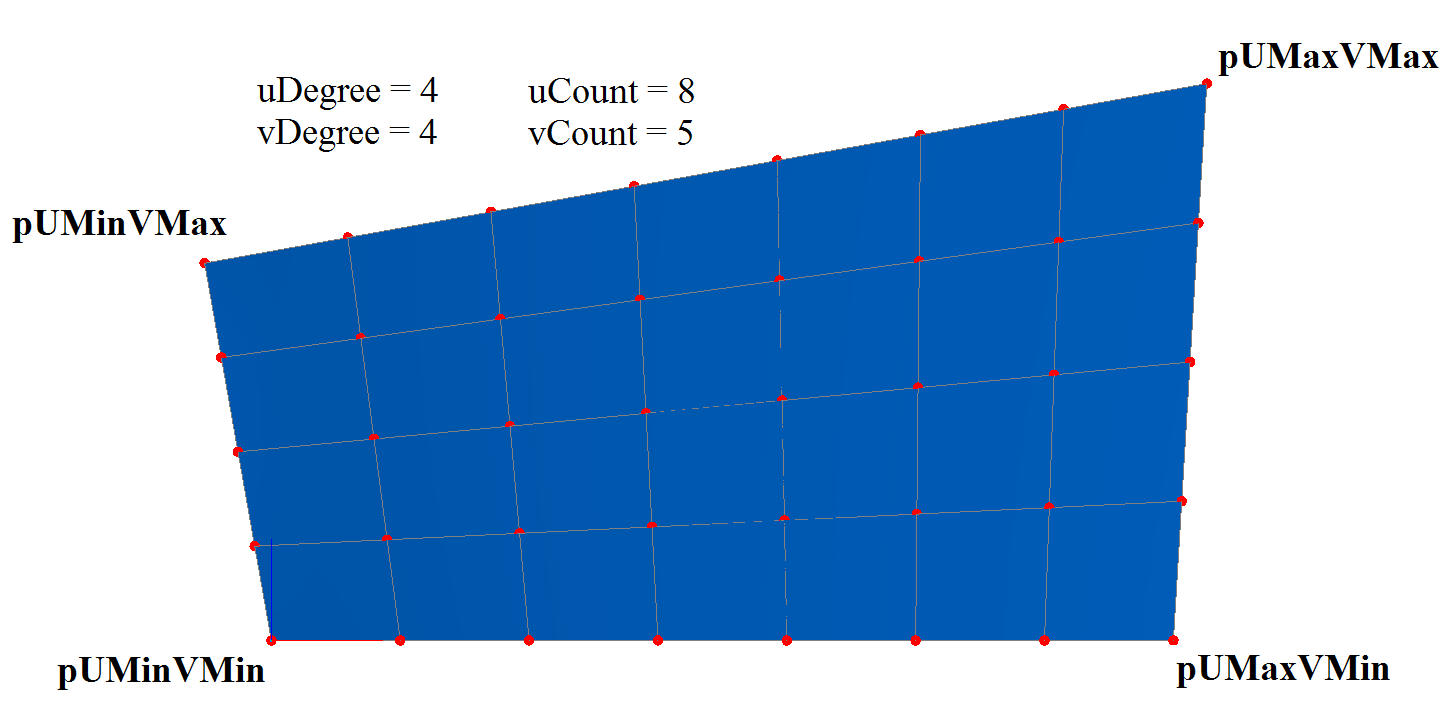
Fig. 1
The weights of all control points are equal to one. The constructed surface is intended for further modification. For the function parameters the following inequalities must hold: uCount ≥ uDegree and vCount ≥ vDegree. The NURBS surface is described in subsection NURBS Surface MbSplineSurface.
The function
MbResultType SplineSurface( const SArray<MbCartPoint3D> & pointList,
                            const SArray<double> &        weightList,
                                  size_t                  uCount,
                                  size_t                  vCount,
                                  size_t                  uDegree,
                            const SArray<double> &        uKnotList,
                                  bool                    uClosed,
                                  size_t                  vDegree,
                            const SArray<double> &        vKnotList,
                                  bool                    vClosed,
                                  MbSurface *&            result );
constructs a NURBS surface by control points and their weights.
The input parameters of the function are:
pointList is a set of control points conventionally arranged as vCount rows with uCount points in each row;
weightList is a set of weights of control points consistent with the set of control points;
uCount is a number of control points along the first parameter (in each row);
vCount is a number of control points along the second parameter (the number of rows);
uDegree is an order of B-splines along the first parameter;
uKnotList is a knot vector of the first parameter;
uClosed is a cyclic closedness of the surface along the first parameter;
vDegree is an order of B-splines along the second parameter;
vKnotList is a knot vector of the second parameter;
vClosed is a cyclic closedness of the surface along the second parameter.
The output parameter of the function is the constructed surface result.
If successful, the function returns rt_Success; otherwise, it returns an error code from the MbResultType enumeration.
The function is declared in the action_surface.h file.
This function constructs a NURBS surface with control points pointList. The control points of the pointList set are divided into conventional rows and columns. Each row contains uCount control points from the pointList set, and the number of rows is equal to vCount. Thus, the pointList set must contain uCount.vCount control points. The order of the surface B-splines along the first parameter is equal to uDegree, and the order of the surface B-splines along the second parameter is equal to vDegree. For the function parameters the following inequalities must hold: uCount ≥ uDegree and vCount ≥ vDegree. The NURBS surface is described in subsection NURBS Surface MbSplineSurface.
The sets weightList, uKnotList, vKnotList may be empty.
If the weightList set is empty, the weights of the control points are equal to one.
If the uKnotList or vKnotList sets are empty, the knot vectors are generated automatically.
If the weightList set is not empty, it must be consistent with the set of control points pointList.
If the uKnotList and vKnotList sets are not empty, they must contain a certain number of elements: for uClosed = false, the uKnotList knot vector must contain uCount + uDegree elements; for uClosed = true, the uKnotList knot vector must contain uCount + 2 · uDegree - 1 elements; for vClosed = false, the vKnotList knot vector must contain vCount + vDegree elements; for vClosed = true, the vKnotList knot vector must contain vCount + 2 · vDegree - 1 elements. Fig. 2 shows the arrangement of control points for constructing a spline surface in the shape of a torus:
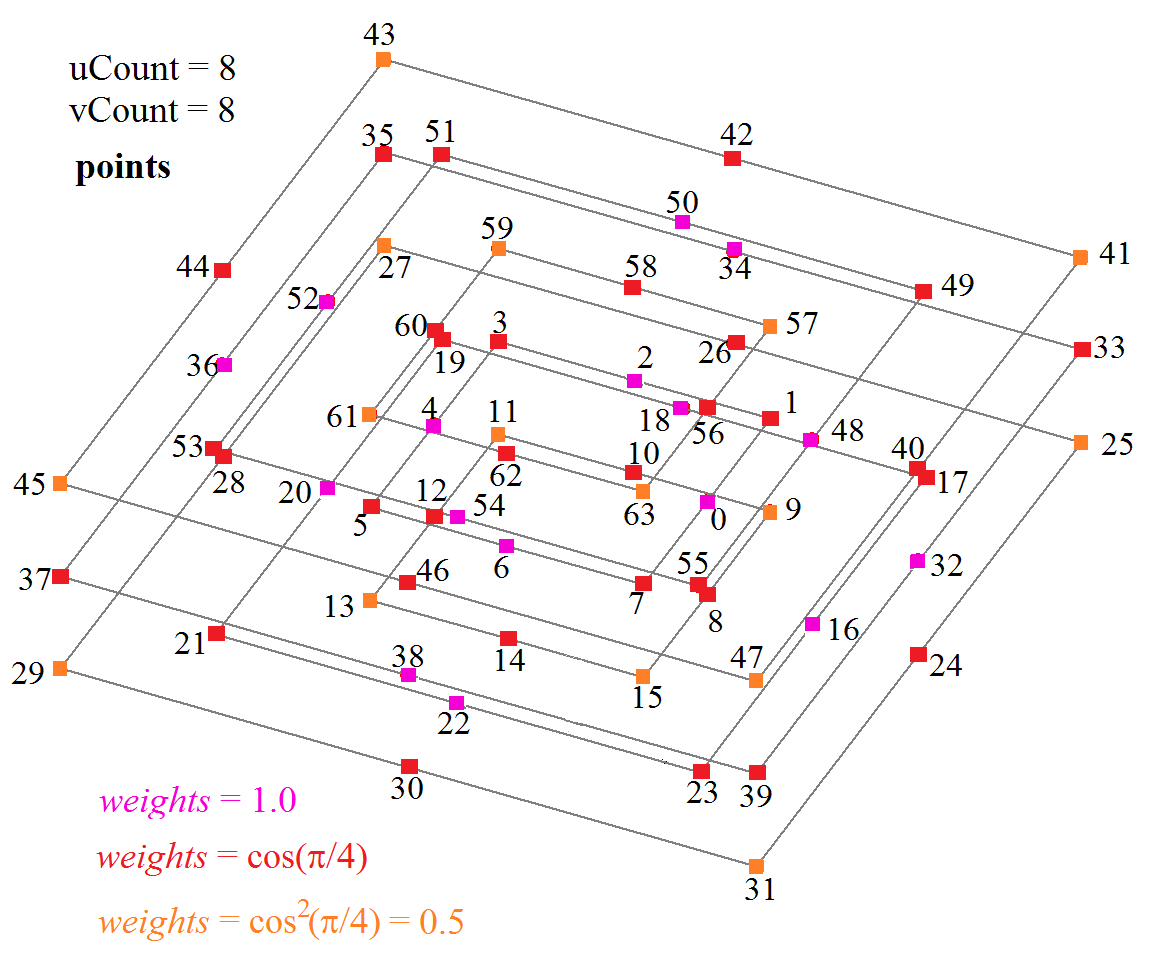
Fig. 2
Fig. 3 shows the spline surface in the shape of a torus constructed on the above control points:
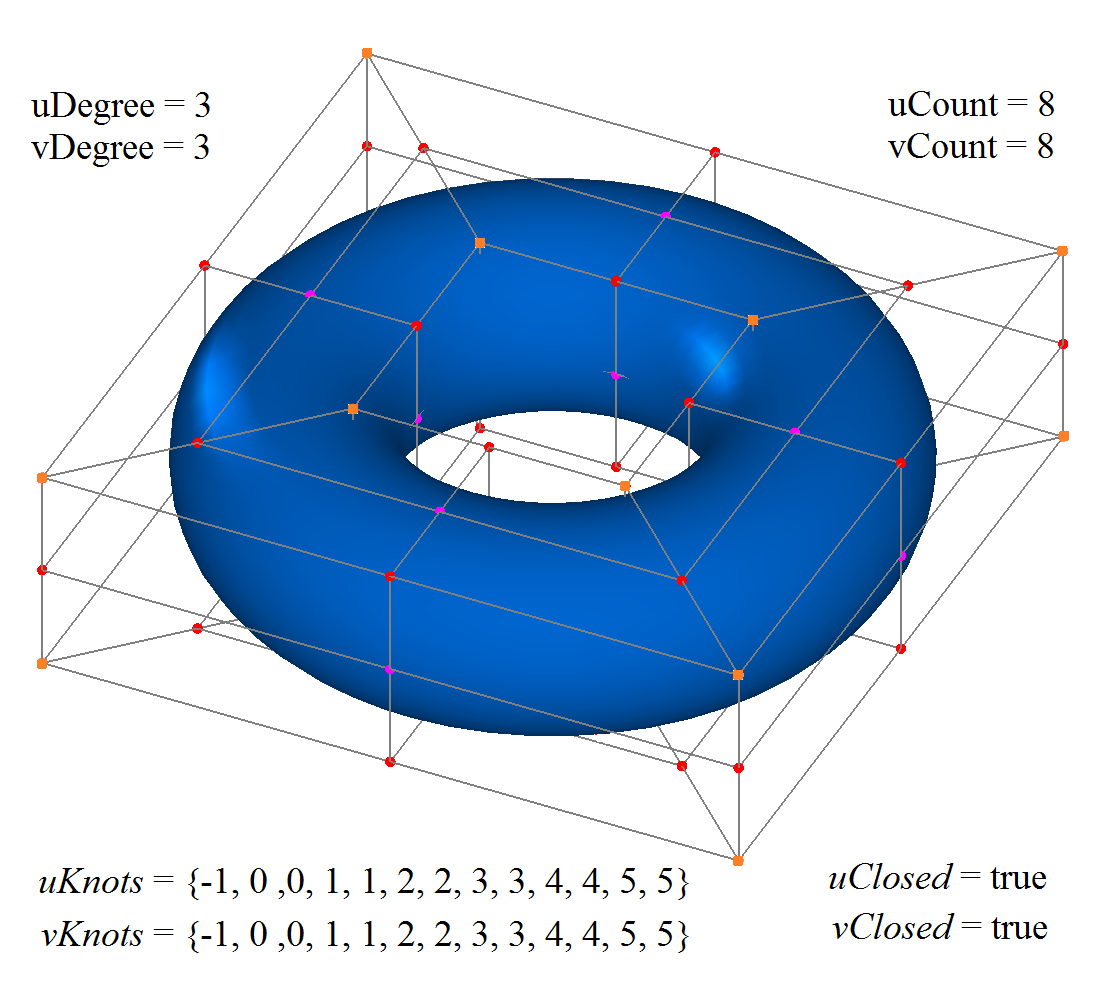
Fig. 3
Below there is an example in the C++ programming language that implements construction of a spline surface in the shape of a torus by this function (the center of the torus coincides with the origin of the global coordinate system, and the torus axis is directed along the global Z-axis):
void AddTorusPoints( double r, double z,
SArray<MbCartPoint3D> & pointList, double w,
SArray<double> & weightList )
{
MbCartPoint3D p( r, 0.0, z );
MbVector3D toX( 1.0, 0.0, 0.0 ), toY( 0.0, 1.0, 0.0 );
double wI( w ), wA = w * ::cos( M_PI_4 );
pointList.Add( p ); weightList.Add( wI );
p.Add( toY, r ); pointList.Add( p ); weightList.Add( wA );
p.Add( toX,-r ); pointList.Add( p ); weightList.Add( wI );
p.Add( toX,-r ); pointList.Add( p ); weightList.Add( wA );
p.Add( toY,-r ); pointList.Add( p ); weightList.Add( wI );
p.Add( toY,-r ); pointList.Add( p ); weightList.Add( wA );
p.Add( toX, r ); pointList.Add( p ); weightList.Add( wI );
p.Add( toX, r ); pointList.Add( p ); weightList.Add( wA );
}

void GetTorusPoints( double majorR, double minorR,
SArray<MbCartPoint3D> & pointList,
SArray<double> & weightList )
{
double zLavel( 0.0 );
double w0( 1.0 ), wA = ::cos( M_PI_4 );
::AddTorusPoints( majorR - minorR, zLavel, pointList, w0, weightList );
::AddTorusPoints( majorR - minorR,-minorR, pointList, wA, weightList );
::AddTorusPoints( majorR ,-minorR, pointList, w0, weightList );
::AddTorusPoints( majorR + minorR,-minorR, pointList, wA, weightList );
::AddTorusPoints( majorR + minorR, zLavel, pointList, w0, weightList );
::AddTorusPoints( majorR + minorR, minorR, pointList, wA, weightList );
::AddTorusPoints( majorR , minorR, pointList, w0, weightList );
::AddTorusPoints( majorR - minorR, minorR, pointList, wA, weightList );
}

void GetTorusKnots( double tBeg, double tEnd,
SArray<double> & knots )
{
double dt = ( tEnd - tBeg ) / 4.0;
double t = tBeg - dt; knots.Add( t );
t = tBeg; knots.Add( t ); knots.Add( t );
t += dt; knots.Add( t ); knots.Add( t );
t += dt; knots.Add( t ); knots.Add( t );
t += dt; knots.Add( t ); knots.Add( t );
t = tEnd; knots.Add( t ); knots.Add( t );
t += dt; knots.Add( t ); knots.Add( t );
}

MbSurface * CreateTorusSurface( double majorR, double minorR )
{
MbSurface * result( NULL );
MbResultType res( rt_Error );
if ( majorR > METRIC_NEAR && majorR > minorR - EPSILON ) {
SArray<MbCartPoint3D> pointList( 64, 1 );
SArray<double> weightList( 64, 1 );
SArray<double> uKnotList( 13, 1 );
SArray<double> vKnotList( 13, 1 );
size_t uDegree( 3 ), vDegree( 3 );
size_t uCount( 8 ), vCount( 8 );
bool uClosed( true ), vClosed( true );
::GetTorusPoints( majorR, minorR, pointList, weightList );
::GetTorusKnots( 0.0, 4.0, uKnotList );
::GetTorusKnots( -2.0, 2.0, vKnotList );
res = ::SplineSurface( pointList, weightList, uCount, vCount, uDegree, uKnotList,
uClosed, vDegree, vKnotList, vClosed, result );
}
return ( res == rt_Success ) ? result : NULL;
}
The function
MbResultType NurbsSurface( const MbSurface &   surface,
                                 VERSION       version,
                                 MbSurface *&  result );
constructs a NURBS copy of a given surface.
The input parameters of the function are:
surface is the source surface;
version is the construction version.
The output parameter of the function is the constructed surface result.
If successful, the function returns rt_Success; otherwise, it returns an error code from the MbResultType enumeration.
The function is declared in the action_surface.h file.
This function constructs a NURBS surface whose shape reproduces the shape of the source surface. The NURBS surface is described in subsection NURBS Surface MbSplineSurface. For most surface types the NURBS copy coincides in shape completely with the source surface. If it is impossible to reproduce the shape of the source surface exactly, the NURBS copy approximates the source surface.
If the source surface is a surface with arbitrary borders MbCurveBoundedSurface, which is described in subsection Surface with Arbitrary Borders MbCurveBoundedSurface, this function constructs a surface with arbitrary borders whose base surface is a NURBS copy of the base surface of the source surface.
In the test application test.exe, construction of a NURBS surface is performed by the menu command «Create → Surface → Based on points → NURBS».