Maxim Kulagin, Head of Technical Support, and Olga Tsirkunova, Head of Business Development, C3D Labs, provide answers to frequently asked questions about the company's products.
Question: What is C3D Toolkit?
Answer: C3D Toolkit is not an off-the-shelf CAD system but a set of components such as Modeler, Solver, Converter, Vision, etc. for software development. These components perform basic operations with geometry and provide an API for creating applications. The user implements specific business logic (like CAE analysis meshes).
Question: Is the C3D kernel a full-fledged CAD system?
Answer: No. The kernel performs basic mathematical operations and algorithms. Specific functions for the end user are created at your application level. We do the math foundation, and you build your system on it.
Question: In what format is the C3D Toolkit provided?
Answer: The user receives dynamic libraries built for a specific operating system (.dll for Windows, .so for Linux, .dylib for macOS), C++ header files, and files for linking the toolkit to user projects.
Question: What examples and other materials are included in the installation package?
Answer:
The installation package includes:
- A test application serving as an example of how to use functions from the C3D Modeler, C3D Solver, C3D PolyShaper, C3D Converter, C3D B-Shaper, and C3D Collision Detection modules on Windows and Linux.
- A C# wrapper for the same modules on Windows and Linux.
- Examples of C3D Vision–based visual applications in C++ with a GUI created using the Qt library (Windows and Linux) or the MFC library, as well as a C# wrapper for Windows.
- Full documentation for the API and build procedures.
Question: Do I need to create a GUI and business logic for my application?
Answer: Yes. We provide the building blocks, and you develop the user interface and business logic on top of them.
Question: What if I need support for Android or other mobile platforms?
Answer: C3D Toolkit builds for mobile platforms are available upon request. They are not included in the standard installation packages, but can be provided if needed.
Question: What programming language is the geometric kernel written in?
Answer: The geometry kernel and all its components, except for WebVision, are written in C++. This is the kernel's native language. If you develop your application in C++, you can access the entire C3D Toolkit functionality.
Question: Are other languages supported?
Answer: Yes, we have wrappers for C#. There is also an intermediate C wrapper. In the future, the C3D kernel will support more programming languages.
Question: Builds for what operating systems are available?
Answer: The builds are available for Windows, Linux, and other systems. There are also special builds for Baikal and Elbrus processors.
Question: Does the kernel support the m3d format (KOMPAS-3D files)?
Answer: No, the kernel does not support the m3d format directly. It is a proprietary binary format supported at a higher level in KOMPAS-3D. The C3D kernel is at a lower level. It has no information about the structure of this file type and does not support it. But there is a workaround for reading m3d files: the KOMPAS-Invisible technology. With it, you can read an m3d file using the KOMPAS-3D API, export it to the c3d format, and then process it in the C3D kernel. This is the most convenient way at the moment.
Question: What is the licensing policy for the geometry kernel?
Answer: We offer flexible licensing options to meet every use case, goal, and customer capability. The most common option is a commercial license. This involves annual payments for the right to use the kernel and includes technical support, requests for new functionality, and royalties on sales of your final product.
Question: What other licensing options are available?
Answer: A corporate license applies when the product is developed for in-house use or as a network-based solution. In this case, the price is determined on an ad hoc basis: we discuss the specific conditions of use and offer a customized license model.
Question: Is technical support included in the license?
Answer: Yes, absolutely. We not only provide technical support, but also closely collaborate with each user to meet their specific needs.
Question: What software development skill level is required to work with the geometric kernel? (This is a frequent question from startups that create engineering software)
Answer: We cannot give a specific answer such as "one senior, two middles, 38 juniors." Working with the geometry kernel requires a good understanding of geometry. Quite often, programmers of engineering applications have an engineering background. It is crucial to understand why and how each function is used and to have a good command of the programming language. One should also be an expert in the subject matter, since we are not always experts ourselves and rely on the customer.
Question: What about the documentation? Is it sufficient?
Answer: We get asked this regularly. Please note that the documentation is open and available to everyone, not just active users. You don't need to sign a contract or pay to read it. It is published on our website.
Question: How do you communicate with users?
Answer: We try to take care of the hardest part: the math, complex calculations. We treat each user individually and work closely with them to develop their products.

Maxim Kulagin,
Head of Technical Support,
C3D Labs
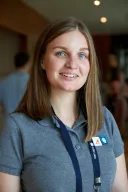
Olga Tsirkunova,
Head of Business Development,
C3D Labs